Few elements can make or break an event faster than the ratio of service staff to guests. When a catering team is understaffed, the consequences ripple across the entire room: drinks sit empty at the bar, cleared plates pile up on dining tables, dinner service stretches past the scheduled timeline, and food arrives lukewarm. Conversely, overstaffing inflates labor costs, erodes catering margins, and clutters the floor with idle crew members getting in the way of guests and photographers.
Determining the ideal staffing count is not as simple as applying a universal formula. While industry shorthand often defaults to basic rules of thumb, seasoned banquet managers and event producers know that service style, venue architecture, beverage complexity, and event pacing fundamentally alter labor requirements. Getting your numbers right requires looking beneath surface headcount and examining how physical logistics and guest expectations intersect on event day.
Service Style as the Baseline for Staffing
The method used to deliver food to the table establishes the primary baseline for your front-of-house roster. Each service format imposes different physical demands on the staff, shifting the balance between front-facing hospitality and back-of-house support.
Plated Dinners
Plated meals demand the highest server-to-guest ratios because every attendee expects their course delivered within a narrow window. A delay of ten minutes between table one and table twenty turns what should be a cohesive dining experience into a disjointed ordeal.
For standard three-course plated dinners, the industry standard sits at one server for every 10 to 12 guests, which translates roughly to one server per ten-top table. This allows a server to handle bread service, pour water, deliver entrees, and clear chargers without feeling hurried.
If the client requests white-glove, synchronized service where every dish at a table is placed down at the exact same second, that ratio tightens substantially. Synchronized service typically requires one server for every 6 to 8 guests. In this setup, servers operate in tandem pairs, with dedicated runners feeding plates continuously from the hot line so floor staff never leave their assigned zones.
Buffet Service
Clients often assume that buffets require minimal labor because guests serve themselves. While kitchen plating labor decreases, floor maintenance and guest support responsibilities rise.
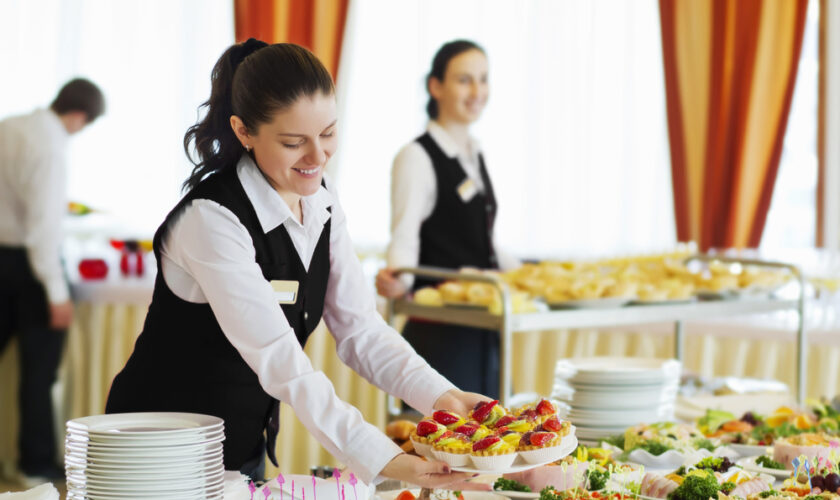
A reliable ratio for standard buffet dining is one server for every 25 to 30 guests. These staff members do not simply stand by; they are responsible for:
-
Monitoring chafer temperatures and swapping hotel pans before food runs low.
-
Wiping down drip edges and keeping carving and sauce stations pristine.
-
Pouring table water and tending to beverage refills throughout the meal.
-
Bus-running used plates, silverware, and glassware as soon as guests return for second visits.
If a buffet features attended carving stations, pasta action stations, or customized toss stations, plan for at least one dedicated culinary attendant per station in addition to the floor server count.
Family-Style Service
Family-style dining has surged in popularity because it combines the seated comfort of a plated meal with the communal atmosphere of a shared table. However, it is deceptively labor-intensive.
Heavy, heated platters and bowls must be carried to tables simultaneously, requiring careful spatial coordination so guests have room for their glassware, floral arrangements, and individual settings. Furthermore, servers must retrieve large platters once emptied to keep tables from feeling overwhelmed.
For family-style service, allocate one server for every 12 to 15 guests. Anything less leads to bottlenecks at the kitchen pass and leaves tables covered in empty, sauce-streaked ceramicware long after the food is consumed.
Passed Hors d’oeuvres and Cocktail Receptions
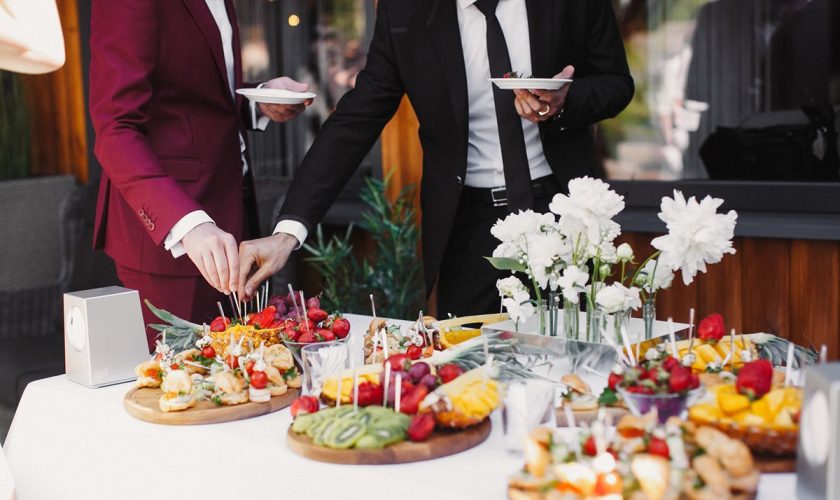
During cocktail hour, the dynamic shifts from seated service to fluid movement. Guests mingle across the room, creating shifting clusters that servers must navigate with loaded trays.
For light hors d’oeuvres, plan for one server per 25 to 30 guests. If the reception serves as a cocktail-style dinner replacement with substantial, continuous bites, tighten the ratio to one server per 20 guests. Additionally, always schedule dedicated floor bussers whose sole job is circulating with trays to collect discarded skewers, cocktail napkins, toothpicks, and empty glasses from high-top tables and lounge areas.
Factoring in the Hidden Backbone: Support Staff
Focusing solely on table servers overlooks the back-of-house engine that keeps service moving. A floor team cannot execute smoothly if they have to leave their sections to wash glasses, scrape plates, or hunt down hot entrees in the kitchen.
Food Runners
Food runners serve as the high-speed link between the executive chef on the plating line and the floor servers stationed in the dining room. By utilizing dedicated runners, floor servers remain in their assigned sections, attending to water glasses, pouring wine, and engaging guests.
For seated events over seventy-five guests, schedule one runner for every two to three floor servers. When serving large banquets in spaces with long transit paths between the kitchen and dining area, runners are essential to ensure entrees arrive at the proper temperature.
Bussers and Scullery Crew
Bussers protect the visual elegance of the room. While servers focus on course drops and guest interaction, bussers clear bread baskets, empty glassware, and soiled plates. For formal seated events, allocate one busser for every 30 to 40 guests.
Behind the scenes, dedicated scullery staff manage trash, sort flatware, run portable dish machines, and handle glass racks. For events exceeding one hundred guests, neglecting dedicated dish stewards forces servers off the floor to clean their own service pieces, stalling the meal schedule.
The Event Captain
Every event with more than four staff members requires a non-serving captain or floor manager. The captain does not carry trays. Instead, they act as the conductor: liaising with the event planner, keeping the banquet event order running on time, signaling the kitchen when to fire courses, and handling guest special requests. Without an unburdened captain, small friction points quickly escalate into operational bottlenecks.
Architectural and Layout Considerations
Standard staffing formulas assume an ideal floor plan with a hot kitchen directly adjacent to the dining room. In the catering world, however, ideal conditions are rare. The physical space dictates labor efficiency just as much as guest count.
-
Distance to the Galley: If the prep kitchen sits in a basement, behind an outdoor service tent fifty yards away, or down a long flight of stairs, travel time doubles or triples. Add twenty to thirty percent more runners to compensate for transit times.
-
Elevator Dependence: Multi-floor venues that require service staff to share a single elevator create unavoidable delivery delays. Staggering courses and adding stationary expediting stations on the dining floor becomes mandatory.
-
Table Distribution and Room Density: Tightly packed rooms with narrow aisles slow down servers carrying large oval trays on shoulder jacks. Wide, sprawling layouts require more steps per table. Both extremes reduce the number of guests an individual server can manage effectively.
Beverage Service and Bar Staffing
Bars are notorious for generating the longest, most frustrating lines at any catered gathering. Calculating bar staff requires examining what is being served and when guests will hit the bar hardest.
For a beer and wine bar, one bartender per 75 guests is usually sufficient to maintain a steady flow. For a full bar with custom cocktails, complex garnishes, and made-to-order mixed drinks, that ratio must drop to one bartender per 50 guests.
Furthermore, beverage staffing requires supporting labor:
-
Barbacks: For any bar serving more than one hundred guests, pair the bartender with a barback. The barback handles ice replenishment, fruit prep, beer restocking, and glassware rotation, allowing the bartender to keep their eyes up and hands pouring.
-
Table Wine Service: If you plan to pour wine tableside during a plated dinner, do not assume your standard floor servers can absorb that workload without falling behind on food service. Either add dedicated wine stewards at a ratio of one per 30 to 40 guests or ensure your dinner servers carry a reduced table load.
Timeline Pressure and Pacing
The event schedule dictates the intensity of service. A corporate awards banquet that allocates forty-five minutes for a three-course dinner requires an aggressive staffing model compared to a relaxed wedding dinner spanning two hours.
When a timeline is compressed, the window for error vanishes. To drop salads, clear bowls, deliver entrees, pour champagne, and clear dinner plates within a tight window, servers need smaller assigned stations. If the client demands rapid-fire transitions to accommodate speeches or keynote presentations, tighten your ratios by twenty to twenty-five percent. The investment in extra labor hours guarantees that service never interrupts the program.
Evaluating staffing ratios is fundamentally an exercise in risk management. By looking beyond simple formulas and adjusting for service style, support staff, physical distance, and schedule pressure, catering professionals can build realistic, profitable labor plans that deliver smooth execution from the first welcome drink to the final coffee pour.